Compliance training
The training system for RIAs.
You’re not too busy to do training. You don’t have a system.
10 rule-cited courses, nine of them also facilitated. 24.5 hours of instruction, 32 lessons, 13 scored quizzes, built. Enrollment fires on join, reminders chase, certificates issue, and the record is examination-grade. Configure once.
Here’s what doing it yourself actually costs.
Doing it yourself
This is 243 hours.
A 20-person firm, replicating the Redan compliance catalog by hand: 10 courses, quizzed and rule-cited, with live versions. Every square is an hour of a year one like yours, by our estimate.
Research the rules, course by course · 55 hrs
Outline and iterate · 20 hrs
Draft the slides, cite as you go · 65 hrs
Knowledge checks and quizzes · 16 hrs
Accuracy review, assemble, publish · 30 hrs
Live-session versions · 27 hrs
Deliver, track, record · 21 hrs
Chase the incompletes · 9 hrs
Now run the same year on Redan.
Your year one, on Redan · the rules and the schedule · about 10 hrs of your time
Already built. 10 courses, nine of them also facilitated. 24.5 hours, 32 lessons, 13 scored quizzes, rule-cited throughout, down to the subsection. Runs on its own. Enrollment fires on join, reminders chase, every completion is stamped into the record.
Configure once.
Assignment rules and the annual schedule are your job, about 10 hours of it. The 24.5 hours of instruction are already built. Those hours belong to your people; the ten are yours.
How we counted: rule research at 3–8 hours a course, outlines at 2, slides at 10 minutes each, quizzes and a 2-hour accuracy review per course, live versions of 9 courses, then running year one for 20 people. Every rate is our estimate, including the 10 hours. Check them against your own experience. Counts measured from the Redan catalog, September 2026.
Getting onboarded
How do I get started?
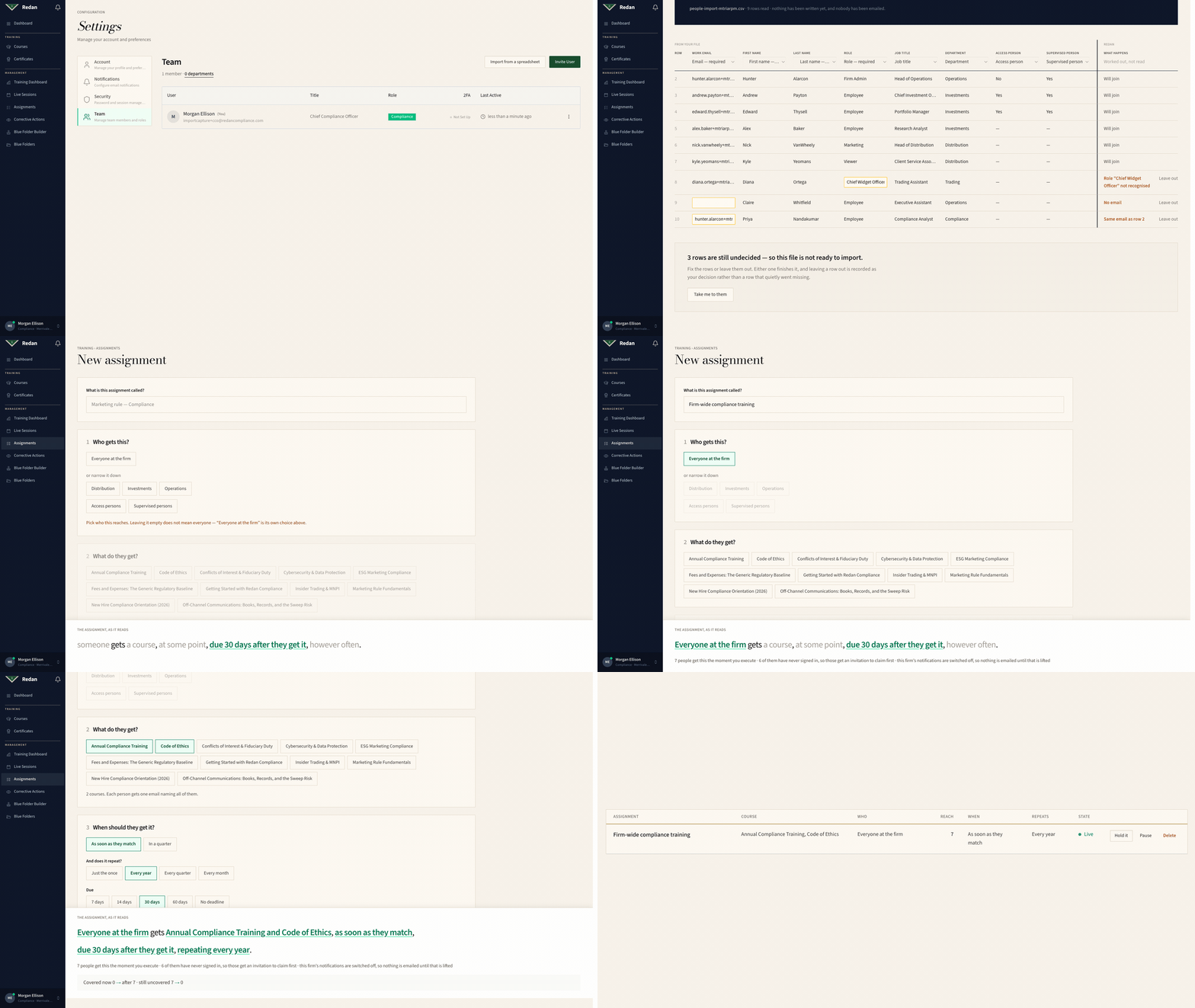
Upload the spreadsheet of your people, make a few decisions, and the courses are assigned. One sitting, and we sit in it with you.
Recording · real firm setup, uncut
Upload
The spreadsheet of your people, the one you already have.
Decide
A few decisions: who gets what, when the year starts.
Done
Courses assigned, reminders armed, the record started.
Assigning training
Who gets what, and when,
in one sentence.
There is no matrix and no workflow builder. You answer four questions, read the sentence they make, and approve it. That sentence is the assignment.
Everyone at the firm gets Code of Ethics, in Q1 2027, due by the close of the quarter, repeating every year.
Halfway through answering, it already reads as a sentence
Everyone at the firm gets Code of Ethics, at some point, by some date, however often.
A handful of these covers a firm. That is the whole configuration.
The product
Follow one completion,
end to end.
One person, one course, five screens. From the assignment that enrolled them to the record it left behind. Every screen is the live product.
Your seat
The assignment catches them
You said who, what, and when. This person matches, so they’re enrolled. Nobody clicked.

Their seat
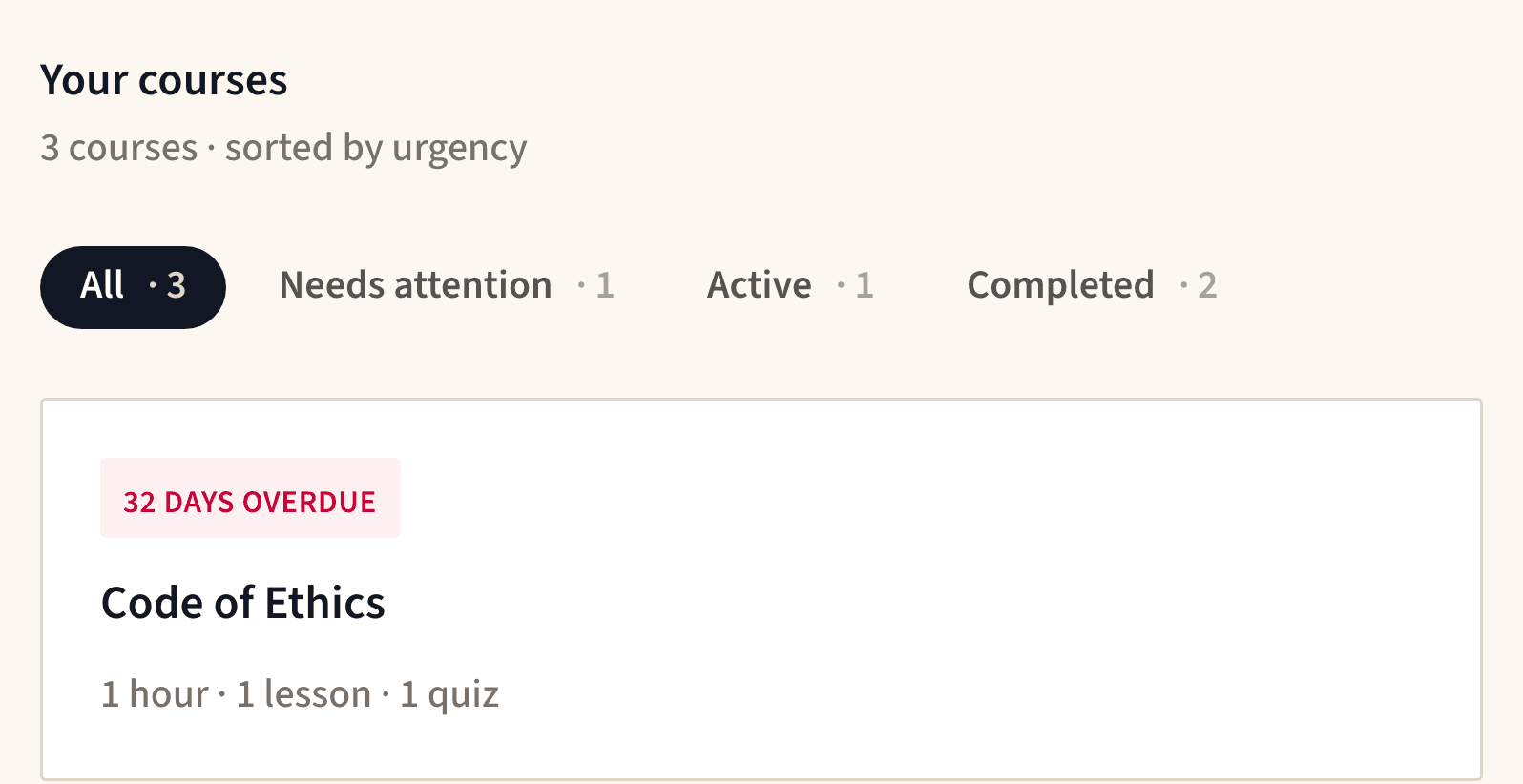
The course is waiting
It’s on their list with a due date, the same as anything else they owe.
Their seat
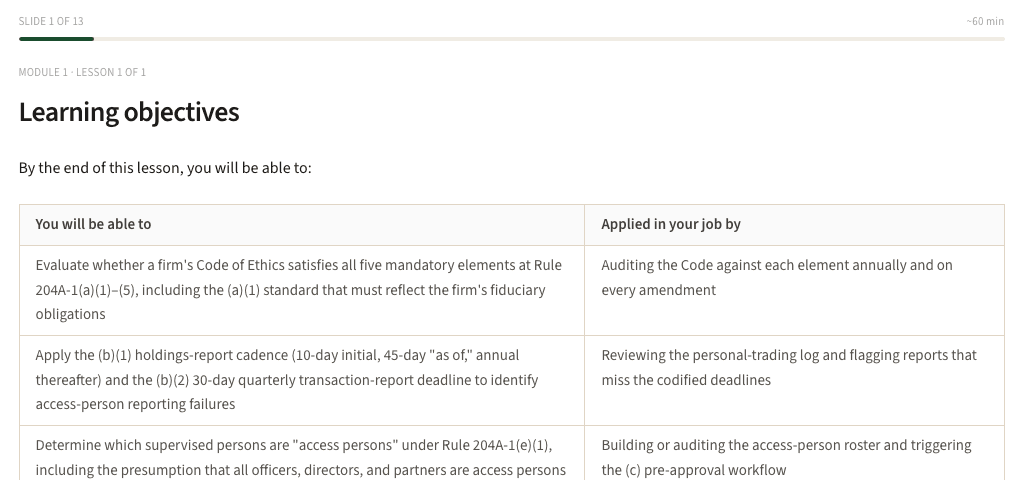
They take it
Plain-language lessons, rule-cited as they teach, then a scored quiz they have to pass.
Their seat
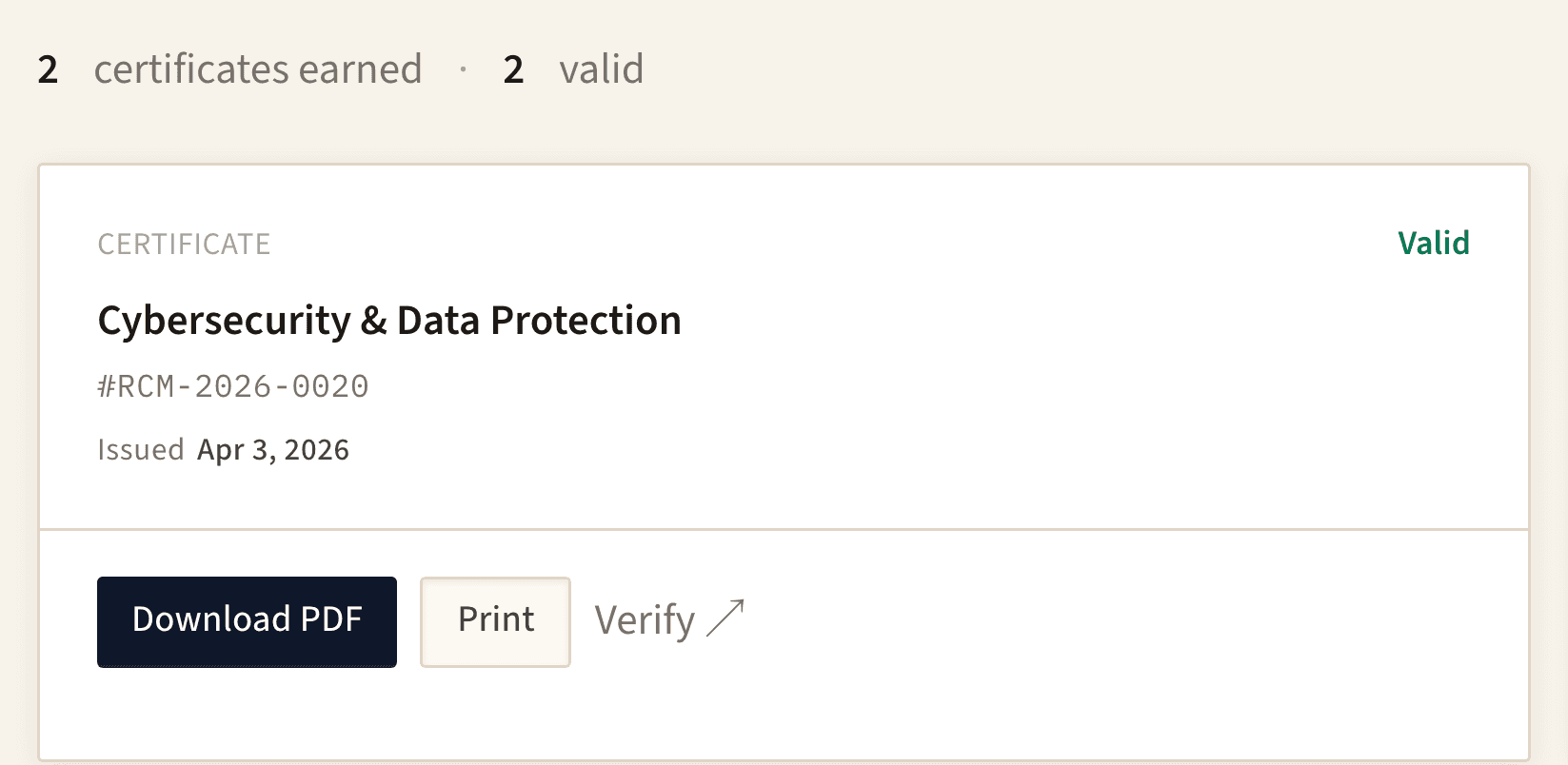
A certificate is issued
The moment they pass. It has a number and a date, it belongs to them, and nothing can change it.
Your seat
It’s on the record
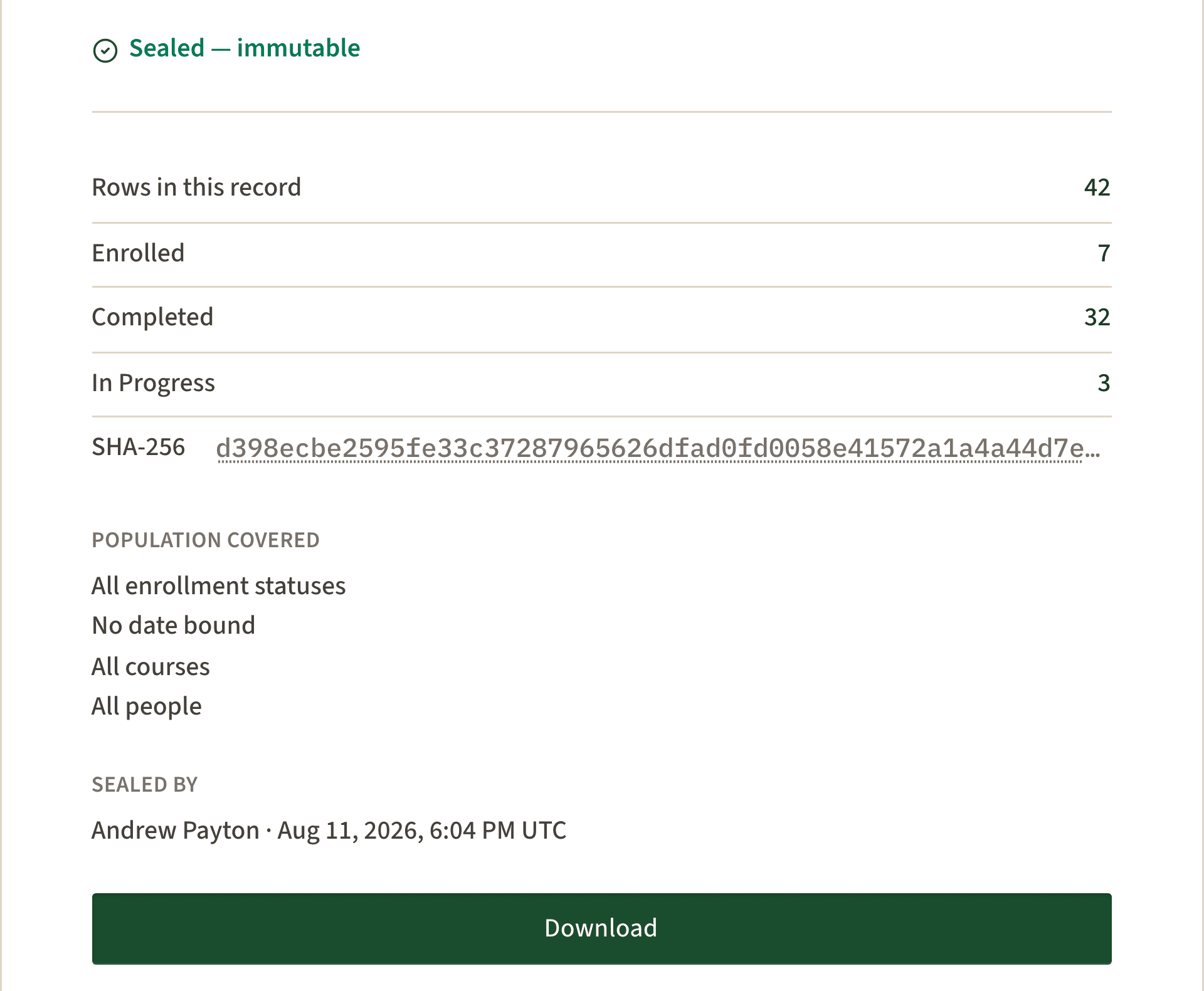
Every assignment, who it reached, what’s complete and what isn’t. On your desk as it happens, and exportable as the examination-grade record.
That chain runs for every person, every course, every year, and no link in it is a task on your desk.
The course content
Here are those finished hours.
Section 2 counted what building this costs. That was 243 hours of your year. This is the other side of that arithmetic: the 24.5 finished hours, course by course, already built and rule-cited.
24.5
Hours of finished instruction
32
Lessons
13
Scored quizzes
Counts measured from the Redan catalog, September 2026. Hours are hours. This is not accredited continuing education.
New Hire Compliance Orientation
Onboarding · 1 hr · 1 lesson
Rule 204A-1 · Rule 206(4)-1 · Regulation S-P
Marketing Rule Fundamentals
Onboarding · 2 hrs · 9 lessons
Rule 206(4)-1 · Rule 204-2(a)(11)
Annual Compliance Training
Annual · 1.5 hrs · 2 lessons
Rule 206(4)-7 · Rule 206(4)-1 · Rule 204-2
Code of Ethics
Annual · 1 hr · 1 lesson
Rule 204A-1 · Advisers Act §204A · Advisers Act §206
Insider Trading & MNPI
Elective · 2.5 hrs · 2 lessons
Advisers Act §204A · Rule 204A-1 · Exchange Act §10(b)
Conflicts of Interest & Fiduciary Duty
Elective · 1 hr · 1 lesson
Advisers Act §206 · Rule 21F-17 · Rule 206(4)-7
Cybersecurity & Data Protection
Elective · 1 hr · 1 lesson
Regulation S-P · Rule 206(4)-7
Off-Channel Communications
Elective · 1 hr · 1 lesson
Rule 204-2 · Rule 206(4)-7 · Advisers Act §204
Fees and Expenses
Elective · 1 hr · 1 lesson
Advisers Act §206(2) · Rule 206(4)-1(d)(1) · Rule 205-3
ESG Marketing Compliance
Elective · 1 hr · 1 lesson
Rule 206(4)-1 · Advisers Act §206
24.5 finished hours
13 self-paced across the ten courses above, plus 11.5 in the nine facilitated sessions · 32 lessons · 13 scored quizzes · measured from the Redan catalog, September 2026
Same blocks as the math above, at the half hour. What costs you 243 hours to build is 24.5 finished hours here, and the annual courses come back around every year on their own.
Plus Getting Started with Redan Compliance, a half-hour platform orientation with no rule to cite. Who gets each course, and when, is one sentence, and section 4’s job. Completions are stamped into the record as they land.
The rollout · our recommendation
Rolling it out is a people problem.
The software is the easy part. The work is people. Three moves, and you can start them in any month of the year.
here
Move 1
Buy-in
Leadership endorses the program before anyone is enrolled. Section 8’s playbook gives you the committee case, ready to use.
Who’s in: Leadership · you
Move 2
Start small
Compliance and the people closest to it go first. A small pilot shakes out the questions while they’re cheap.
Who’s in: Compliance and the desks next to it
Move 3
Go firm-wide
Compliance leads, everyone’s enrolled, the year runs from there.
Who’s in: The whole firm
Any time of year. Every month is a valid start. There’s no January to wait for.
And you don’t do it alone.
We load your roster, write the assignments with you, and stay on it until the first courses have gone out. White glove, until it is.
The playbook
The internal case, written for you.
You’re the compliance officer, the person who has to actually get this done. This is the working document for that job: the committee case, how to run the pilot, and what to say when someone pushes back. Run it on Redan, or use it to raise the standard of the program you already run on your own content. It’s yours either way.
Chapters one to six, condensed to a page you can forward. No email required.
Redan Compliance · working document
The Training Rollout Playbook
Fourteen chapters. The first six are the one-page case you can download.
- 01The asksmall, specific, endorsable
- 02Why nowthe rule’s wording and where examiners look
- 03What changesfour small pieces instead of one big one
- 04What it costssay the increase out loud
- 05What management will seepromise only what the product produces
- 06Why it needs senior managementthe endorsement is evidence
- 07The pilotone quarter, a report back, a way to stop
- 08The training yearfour quarters, one course at a time
- 09Departmentstypical groupings, illustrative and confirmed per firm
- 10When someone doesn’t finishnothing quietly expires
- 11New hiresalways outside the cycle, covered from day one
- 12Talking to your peoplerelevance as respect, and the cases that name a CCO
- 13How this startstwo lists, agreed
- 14On the horizonthe FinCEN anti-money-laundering rule
Questions
The questions you might have.
Can I just do this myself?
You can. It is two jobs: the content, and running the program. Write the courses, run the sessions, keep the sign-in sheet, follow up with the people who slip, and keep the record. We put a number on the first job in the math section, about 243 hours by our count. The second job never finishes, and it is the one you can’t let slip.
Who is this not for?
If you need accredited continuing-education credit, this isn’t that. If your training obligations sit mainly outside SEC adviser regulation, this was built for SEC-registered advisers. And if your people already get assigned without anyone remembering to do it, they get followed up when they slip, and at the end of the year there is a record that would hold up, then you’re probably set, and switching buys you little.
What does it cost?
A flat rate per firm, unlimited users. It’s on the pricing page.
Can we run sessions live?
Yes. Each course ships with a paired live-session deck, and attendance is attested into the same record as the self-paced courses.
What does an examiner actually see?
The training Blue Folder. One sealed record for the firm: every assignment, who it reached, who completed, who didn’t, every attempt with its score, and the certificates. It carries the population it covers, who sealed it and when, and a hash that proves it hasn’t changed since. It builds as your people train and exports whole.
Can we use our own courses?
Yes. Keep ours, drop what doesn’t apply, bring in your own. A course here needs lessons, a knowledge check and scoring, so getting yours in is something we do with you rather than an upload you do alone.
How fast can we start?
The technical setup is a single call, and you drive most of it: your people from a spreadsheet, who gets which courses, when your year starts. The harder part is standing the program up properly, and we do that with you. Onboarding is white-glove. We sit in it and guide where it’s needed rather than handing you a manual.
The rule
What the rule requires.
Does the SEC require annual compliance training?
No rule says “train.” The compliance rule requires written policies reasonably designed to prevent violations, a review of them at least once a year, and a chief compliance officer to administer them. Redan’s view is that training is how you show the policies are implemented, and that is what examiners check. The SEC staff’s 2020 risk alert on adviser compliance programs lists advisers that “did not train their employees” among the deficiencies it found. If your manual says you train, the exam checks that you did.
Rule 206(4)-7 · OCIE risk alert, 19 Nov 2020
Is code of ethics training required every year?
The rule requires something narrower. Every supervised person gets a copy of the code of ethics and every amendment, and gives the firm a written acknowledgment of receipt, which the firm keeps for five years. Redan suggests an annual code of ethics course with the acknowledgment taken inside it, so the acknowledgment the rule requires sits next to evidence the person read the code.
Rule 204A-1(a)(5) · Rule 204-2(a)(12)(iii)
What records of training does an adviser have to keep?
No rule names one. The books-and-records rule lists what an adviser must keep, and a training record is not on it. Redan suggests keeping one anyway, per person and per course, with completion dates and scores. The 2020 risk alert cites advisers that claimed to perform their annual review “but could not provide evidence that one occurred,” and the same test applies to anything else your policies say you do. A sign-in sheet shows who was in the room and nothing else.
Rule 204-2 · OCIE risk alert, 19 Nov 2020
Who has to take compliance training, everyone or just access persons?
The rules don’t set a training population. The compliance rule covers the firm and its supervised persons, which is everyone the firm supervises. “Access person” is a narrower category from the code of ethics rule, and it governs personal-trading reporting rather than training. Redan’s default is to train every supervised person on the core courses and assign the access-person material to the people the definition covers. The audience is yours to set: everyone, or by department or designation.
Rule 206(4)-7(a) · Rule 204A-1(e)(1)
How many hours of compliance training does an RIA need?
No rule sets a number of hours, and none sets a course list. With no requirement there is no accreditation, so we state courses in hours and never call them continuing-education credit. Redan’s guidance is several courses a year, not one: some that everyone at the firm takes, and some specific to the job each person does. More training is better than less, and it is good business practice as well as good compliance. Redan’s catalog is ten courses, nine of them also facilitated, and 24.5 hours across them. A firm assigns the ones that fit.
No rule sets it
When is annual compliance training due?
The rule sets no date. The compliance rule’s only clock is the annual review of the policies themselves. Redan suggests picking a date and putting it on the compliance calendar, where it comes due the way a filing does. Redan’s calendar defaults annual training to the fourth quarter and new-hire training to within 30 days of hire, and a firm can move both.
Rule 206(4)-7(b)
What happens next
Come and see it run.
Half an hour on a call. Assignment, the chasing, and the record at the end.